
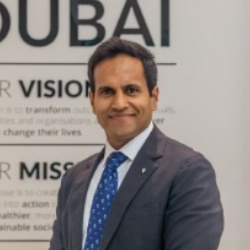
Krishnadas Nanath
Associate Professor, Deputy Head- Computer Engineering and Informatics, Head of Middlesex Insights Lab
“As Principal Investigator, I’m honored to contribute to Dubai’s bold, future-focused vision under the leadership of the Government of Dubai and the Dubai Future Foundation’s RDI initiative. Their mission to position Dubai as a leading city of the future and to fund high-impact research makes this work possible. Our project will turn AI, remote sensing, and field climatology into validated heat-risk intelligence—LST maps, a Heat Vulnerability Index, and a decision-ready GIS dashboard—to protect communities and guide cooler urban design.”
Dubai’s rapid urbanization has intensified the urban heat island (UHI) effect, with built-up land cover increasing by 64.8% and land surface temperatures rising by ~1.5 °C in recent decades. Densely developed districts are significantly hotter than surrounding areas; average nighttime temperatures in urban cores can be up to 3.3 °C higher than in rural zones. This escalating heat places stress on infrastructure and poses acute public-health risks, particularly for outdoor workers, older adults, and underserved communities with limited access to cooling. Despite the scale of the challenge, Dubai lacks a comprehensive, high-resolution system to monitor and respond to urban heat. Current tools rely largely on satellite imagery and sparse meteorological data, offering limited neighborhood-level detail and excluding human vulnerability factors—constraining climate-response planning.
AI for Urban Heat & Human Resilience addresses these gaps by integrating advanced remote sensing, machine learning, and field-based climatology to produce Dubai’s first fully validated, high-resolution Land Surface Temperature (LST) maps. Targeted field campaigns across representative zones (e.g., Deira, Al Quoz, coastal and peri-urban sites) will calibrate satellite estimates. Outputs will feed a Heat Vulnerability Index (HVI) that combines thermal exposure with demographic and infrastructure indicators to pinpoint high-risk areas.
Findings will be delivered through a GIS-based decision-support dashboard that provides actionable, neighborhood-scale intelligence for policymakers and practitioners. The platform is designed to inform targeted cooling strategies, protect vulnerable populations, and guide urban design and operations. By aligning with the Dubai Urban Master Plan 2040 and the UAE’s Net Zero 2050 goals, this project establishes a locally grounded, data-driven framework to mitigate urban heat and strengthen community resilience in a warming climate.