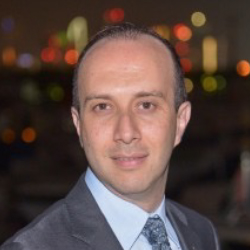
Dr. Fadi Salem
Senior Fellow of Digital Governance and Technology Policy; Director of Policy Research Department, Mohammed Bin Rashid School of Government
"Leveraging two decades of pioneering research in technology policy, AI, and digital governance at the Mohammed Bin Rashid School of Government, I am proud to lead a team of Dubai-based and international researchers at Stanford University in launching the AI-Atlas UAE project. We are grateful for the generous support by Dubai RDI. More than a robust and innovative research project; we envision that the AI-Atlas will serve as a foundational participatory initiative with tangible, long-lasting impact and a crucial contribution to realizing Dubai's cognitive city vision. Through its scientific and policy pillars, the AI-Atlas will provide an essential view that policymakers, researchers, and innovators critically need. As AI innovations rapidly accelerate across the city, we are building more than a map; we are actively constructing an informational foundation that fills existing gaps and solidifies new pathways to responsible AI innovation."
With the global rise of “cognitive cities” urban centers are leveraging Artificial Intelligence (AI) for smarter services, yet many initiatives remain fragmented and lack robust ethical oversight. Some cities utilize digital twins, others employ public AI registries, but most cities face similar challenges: siloed AI data, fragmented projects, and high-level ethical guidelines that aren’t systematically and actionably embedded into project deployment. This creates risks around bias, privacy, and transparency, hampering holistic urban innovation. The AI-Atlas UAE project is a multi-year initiative designed to address these gaps by creating a real-time observatory platform that maps and monitors AI deployments across Dubai. Built on over a decade of technology policy and AI governance research at MBRSG, the project is structured around four core goals. First, it will develop an interactive citywide AI mapping dashboard, culminating in the AI-Atlas 2.0 Real-Time Platform which will visualize over 100 AI projects, integrate live urban data streams, and provide predictive analytics. Second, the project will create an “ethics-by-design” toolkit to operationalize established AI Ethics principles, co-designed and piloted with municipal departments and local SMEs by Year 2, and integrated into city procurement guidelines by Year 3. This toolkit includes practical resources, promoting responsible AI adoption and ensuring inclusive design. Third, the project will actively engage the innovation ecosystem—government, start-ups, SMEs, academia, and citizens—through annual stakeholder roundtables and the forging of data-sharing partnerships, contributing to economic growth, visibility and fostering a collaborative “living lab” environment. Finally, it will produce knowledge outputs including policy briefs, a comprehensive research report, and scholarly papers contributing to inform global cognitive city governance. Collectively, the AI-Atlas UAE will provide a transparent, data-driven, and ethically-informed foundation for smarter governance, ensuring Dubai’s cognitive city development maximizes public value and institutionalizes responsible AI norms.